
The right commercial floor depends on three things: what the floor has to survive, what your customers need to see, and how long you can afford to be closed. A shop or warehouse needs traffic and chemical resistance first. A salon or barbershop needs chemical resistance, easy cleanup, and a look that fits the brand. A lobby needs to impress and stay safe in wet weather. And every business needs the install scheduled around operating hours.
We’ve installed floors in shops, salons, lobbies, and a barber school, and the same questions come up every time. Here’s how we answer them.
Start With Your Schedule
For most business owners, the first question isn’t color or chemistry. It’s “how long will I be closed?”
The honest answer depends on the square footage, the condition of the slab, and the product. What we can usually do is plan the job so the downtime lands where it hurts least.
Ways we work around operating hours
- Phasing. Larger spaces can often be done in sections, so part of the business stays open while we work on another part.
- Closed days. Many salons and barbershops close one or two days a week. We can often plan around those days.
- Product selection. Faster-curing systems, like polyaspartic topcoats, can shorten the time before the space is back in use. Return-to-service times depend on the product and conditions, and we’ll spell them out in your quote.
- Prep ahead. Some repair and layout work can be done in advance to shorten the closed window.
A verified Google reviewer described one project like this: “It was a quick 2-day project roughly 4hrs each day. Mario and his crew were prompt and on-time every day.” Not every job is that short, but good planning makes a big difference.
What the Floor Has to Survive
Different businesses put very different stress on a floor.
| Space | Main stresses | Systems we typically consider |
|---|---|---|
| Auto, fabrication, or garage shop | Oil, fluids, rolling loads, dropped tools, hot tires | Flake or quartz with durable topcoat |
| Warehouse | Forklifts, pallet jacks, abrasion over large areas | Polished concrete or high-build coating |
| Salon | Hair color, bleach, chemical spills, chair bases | Metallic or solid epoxy with chemical-resistant topcoat |
| Barbershop | Hair, clippings, constant sweeping, chairs | Metallic or flake with smooth, cleanable finish |
| Lobby or reception | Foot traffic, rain at the door, first impressions | Metallic, flake, or polished concrete with slip-resistance near entries |
Chemical resistance
Shops deal with motor oil, brake fluid, solvents, and degreasers. Salons deal with hair color, developer, bleach, and acetone. A resin system with the right topcoat resists those far better than bare concrete or most sealers. That said, almost any surface can stain if a strong dye dries on it, so we always recommend wiping up spills promptly.
Traffic and impact
Rolling toolboxes, car lifts, pallet jacks, and dropped parts are tough on any floor. Thicker build and broadcast systems add impact resistance. For heavy point loads, such as lift posts or racking, we look at the slab and the anchoring before recommending a system.
Grip: Quartz and Flake for Working Floors
Slip resistance is a safety issue in any business, and in some spaces it’s a daily concern.
Flake systems
A full flake broadcast creates a textured surface and hides dirt between cleanings. It’s a natural fit for shops, garages, back rooms, and break areas. Our flake epoxy flooring page shows how those systems are built.
Quartz systems
Quartz broadcast systems use colored quartz aggregate instead of flake. They’re very durable and can provide more aggressive grip, which suits wet areas, wash bays, and spaces with heavy traffic.
Topcoat additives
For smoother finishes, like metallic floors in salons or lobbies, we can add fine anti-slip grit to the topcoat in the areas that need it most, such as entries and wash stations. The more texture, the more grip, but also the more effort it takes to clean. We’ll help you find the balance for each zone.
Metallic for Showpiece Spaces
When the floor is part of the customer experience, metallic epoxy is hard to beat. Salons, barbershops, boutiques, and lobbies use it because it creates depth and movement that customers notice the moment they walk in. See our metallic epoxy page for how those floors are created.
Adriana R. wrote about her salon: “Mario and his team did an amazing job with my salon floors! The detail and metallic shimmer is stunning.” Maria S. kept hers short: “Awesome work! Made my lobby look so good!”
The tradeoff with metallic in business settings
Metallic floors show scratches more than flake or polished concrete, especially in high-traffic areas and darker colors. In a salon, rolling stylist chairs and stools are the main culprit. We recommend chair mats or casters suited to hard floors at each station, and a good entry mat to keep grit out. Over time, a worn topcoat can be refreshed without starting over.
A barber school we donated
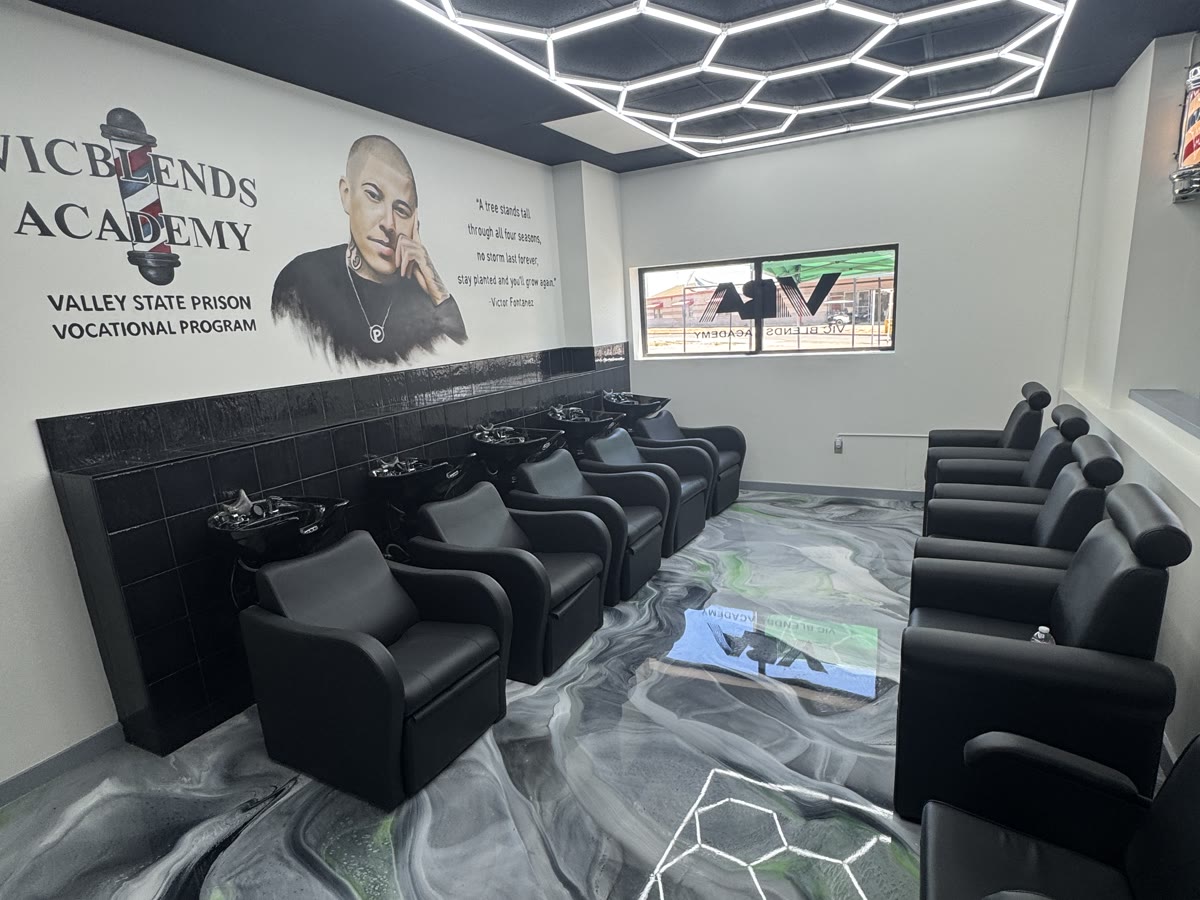
One of the projects we’re proudest of is a barber school metallic floor our team donated. Barber schools see constant traffic, chairs rolling all day, and endless sweeping of hair and clippings. A seamless metallic floor with a durable topcoat holds up to that routine and gives students a professional space to train in.
Dust Control: Keeping Your Business Clean
Preparing a commercial slab means grinding, and grinding concrete creates dust. In an occupied building or next to a working storefront, dust control isn’t optional.
We use planetary diamond grinders with HEPA dust extraction, which captures most of the dust at the source. We also:
- Seal off doorways and HVAC returns where needed.
- Protect inventory, fixtures, and equipment that can’t be moved.
- Clean up at the end of each work day so you’re not walking into a mess.
Our concrete grinding page explains why mechanical prep is better than acid-etching for long-term bond, especially in commercial spaces.
Polished Concrete for Large Slabs
For warehouses, showrooms, and large open shops with a sound slab, concrete polishing is often the most practical floor. There’s no coating to wear through, it handles forklift and pallet-jack traffic well, and routine care is mostly dust mopping and auto-scrubbing.
The catch: polished concrete shows the slab’s history. Cracks, patches, stains, and old anchor holes stay visible. On an older building with a lot of history in the slab, a coating may give you a cleaner result. Our article on polished concrete vs. epoxy goes deeper on that choice.
Shops and Outbuildings
Shop floors, from metal buildings to detached garages used for work, get a lot of abuse. Fluids, rolling loads, welding sparks, and dropped tools all happen in a normal week.
Daniel A. described his experience: “Mario was super easy to work with and the crew showed up ready to work. Very respectful and attention to detail was amazing. We did a 30x40 shop and it looks amazing.”
For shops, we usually recommend a flake system with a durable topcoat. It resists fluids, hides dirt, and adds grip. Our metal building shop floor project shows what that looks like in a working space.
Cleaning and Maintenance for Business Floors
A coated or polished commercial floor is easy to keep clean, which is a big part of its appeal.
- Daily: Dust mop or sweep. In salons and barbershops, that’s already part of the routine.
- Weekly or as needed: Damp mop or auto-scrub with a pH-neutral cleaner.
- Spills: Wipe up chemicals, color, and fluids promptly.
- Entry mats: Keep grit and water from the parking lot off the main floor.
- Periodic refresh: High-traffic areas can be recoated or burnished over time.
Avoid harsh solvents and abrasive pads on coated floors. They dull the topcoat faster than traffic does.
Choosing the Right System
The best commercial floor is the one that matches how your business actually works. A salon needs something different from a fabrication shop, and a lobby needs something different from a warehouse. Our commercial epoxy flooring page gives an overview of the systems we install for businesses.
When we visit a commercial space, we look at the slab, ask about your traffic and chemicals, and talk through your schedule before we recommend anything. The goal is a floor that looks right for your customers, holds up to your work, and goes down without costing you more downtime than it has to.


